

Investors in Amazon should be turning a critical eye to its new Data Center Commitment, announced on October 2 by Amazon Web Services, Inc. CEO Matt Garman.
They know that social license to operate has become mission-critical for Amazon, with social friction affecting data center project economics through credit-relevant risks, asset impairment, operating costs, revenue loss, and cost of capital. Community relations, once disparaged as a cost center that merely does philanthropy or communications, is now seen more clearly to mitigate material financial risk.
In the analysis that follows, the Amazon Data Center Commitment is assessed for its capacity to preserve social license. Implications are discussed for investors.
Overview
Amazon frames its Data Center Commitment as a series of four tenets, co-announced with a new community investment framework, “Built Together,” which will add more than $1B over the next five years to Amazon’s community programs. The four precepts are:
1. Protecting & Enhancing Communities
Commitments to work with local utilities, regulators, policymakers, and grid operators to ensure that Amazon data centers do not result in increased residential electricity rates and that energy prices paid by the company are adequate to cover energy and infrastructure improvements required for the facilities
2. Providing Jobs & Economic Benefit
Commitments to create “thousands” of skilled jobs, both near-term construction and long-term operations; to pay nationally competitive wages with healthcare benefits from day one on the job; and to prioritize local hiring and procurement “wherever possible”
3. Engaging Communities
Discontinuation of nondisclosure agreements (NDAs) with government agencies; commitments to host open houses in communities where the company operates, offer information about plans “as early as possible,” and to share engineering innovations through a Sustainability Exchange.
4. Building & Operating Responsibly
Statements describing current carbon-free energy portfolio and data center energy efficiency; commitments to being “water positive across our data centers by 2030, returning more water to communities than we use,” designing data centers to comply with local sound requirements at site perimeter, invest in energy grid and water infrastructure upgrades, use backup generators in new sites that meet EPA Tier 4 emissions standards or equivalent, and publish metrics annually for public review concerning energy use, energy efficiency, water use, water efficiency, and percent of energy from carbon-free sources
No timeline for the operational start or end of these commitments is given.
The community investment framework, “Built Together,” is a U.S.-based program focused where Amazon operates data centers “with communities in the driver’s seat to determine what’s most useful for them across education, job training, energy affordability, water and energy preservation, and local priorities.” The program is organized around three pillars:
1. Education & Workforce Pathways
Subsidized workforce training and community college degree programs; Modular Training Centers providing free certification programs for skilled trades with pathways to employment at Amazon and its construction partners
2. Community Energy Affordability & Water Solutions
Grants for energy efficiency upgrades to schools, other public buildings, and single/multifamily homeowners in counties with Amazon data centers; water conservation and replenishment projects
3. Flexible Funding for Local Priorities with Communities in the Lead
Partnerships with local nonprofits and community foundations to identify and provide funding for community investments
The magnitude is described as “more than $1 billion over the next five years” in addition to “what we’re already doing,” but the combined investment figure is not provided.
Analysis
The Amazon Data Center Commitment will invite comparison with Microsoft’s Community-First AI Infrastructure plan, which was launched in July 2026. (See here for my review of the latter.) Both hyperscalers have now announced stoppage of non-disclosure agreements with local governments in connection with data center projects as part of strategic refreshes for community relations. Both have released sets of community-facing tenets or commitments.
But investors should not allow themselves to get overly distracted by comparing the two approaches. Because they are formulated as a mix of promises and precepts, they give little information about how each company operationalizes and governs its community relations function.
Some questions that I think investors should be asking Amazon:
What evidence can Amazon provide to show that community relations actually make a difference in project design and operations? Instead, if social risks are identified as only “reputational” in the risk register and the company treats community engagement as philanthropy and/or brand management, then the company may fail to secure social license even if it has the right legal permits.
By which method has Amazon integrated social risk into project valuations? Although social risk is widely and wrongly perceived as intangible, it is possible to quantify a social-risk-adjusted net present value.[1] The belief that social risk is incompatible with financial analysis is now a decade out of date.
What is Amazon’s total social performance investment for the data center portfolio, and how does it compare to the associated risk reduction? The “Built Together” framework claims more than $1 billion over the next five years, in addition to current spending, but this information is inadequate to assess how it mitigates related financial risks.
o It also seems to fall notably short of a benchmark issued in September by the state of New York, which recommends community investment of $1M per megawatt of utility demand associated with a data center project.[2] Although Amazon has not revealed exact figures for current capacity, we can do a quick calculation. Morgan Stanley analyst Brian Nowak estimates that AWS will bring on 8GW in 2027.[3] Let’s assume that he is right and in the first full year of the Built Together program, it brings on 8GW (8,000MW). Under the New York community investment framework guideline, the recommended community investment would be $8B for that one year.
Are community inputs reaching corporate decision-makers before or after critical project decisions are made? If decisions are made without social intelligence, or the intelligence is stymied in the wrong silo, then we have warning signs for governance failure.
o Consider an example from another kind of infrastructure development: Energy Transfer Partners (NYSE:ETP), the parent company of the Dakota Access Pipeline, relied exclusively on the U.S. Army Corps of Engineers to engage the Standing Rock Sioux Tribe, whose ancestral lands covered portions of the pipeline route.[4] This created an accountability loophole through which both the company and the government evaded responsibility for community relations, fueling a social conflict estimated to have cost the equity owners not less than $7.5B.[5]
To what extent does the Amazon Data Center Commitment apply to third-party or leased data centers? For example, AWS has entered into colocation arrangements with partners such as Equinix or NTT, and it also offers AWS Dedicated Local Zones, which are a type of on-premises infrastructure managed and operated by AWS and built exclusively for customers.
o Consider that the New York State Comptroller — writing as trustee of the New York State Common Retirement Fund, one of the largest public pension funds in the U.S. — sent a formal letter to Amazon.com Inc. CEO Andrew Jassy and the CEOs of 16 other publicly listed companies informing them that “Rapid growth of leased and third-party data center capacity has reduced transparency and made it harder for investors to assess the scope of a company’s exposure. Where data center infrastructure is delivered through landlords, developers, or service providers, the underlying impacts on communities do not disappear and accountability may be lacking if community-focused commitments apply only to facilities a company directly owns and operates.”[6]
Why Amazon’s public messaging is a red flag for governance failures
I also think that investors should be assessing the language in Amazon’s public announcement to identify warning signs of possible governance failures related to social license for its digital infrastructure business. Several elements of the rhetoric are cause for scrutiny:
Dismissal of negative feedback. The AWS CEO dismisses community concerns as uninformed, politically motivated, or driven by outside agitators:
“in the age of social media and 24/7 news, myths take hold faster than ever before. In fact, this build-out is so important geopolitically that there are widespread reports of various countries intentionally seeding misinformation in the U.S. about data centers to trick us into slowing down. Right now there are over 100 moratoriums being considered across the country.”
From a corporate governance perspective, a statement like this indicates that the company is creating a false sense of security by ignoring claims it interprets as confused or misinformed and/or by eliminating channels through which it might learn of problems. This is a red flag that merits questions from investors.
Metrics without meaningful context. Slim to zero metrics reported in this announcement actually had adequate context to support interpretation, such as trends over time, company targets, peer benchmarks, or calculation methods. As such, these metrics do not support community understanding or oversight by an investor or other relevant stakeholder. I’m not going to spend more effort on how poor the presentation of performance metrics is. You can see for yourself.
Hubristic use of history. Right off the bat, the CEO’s message makes an analogy between the digital infrastructure build-out and that of the national transportation system in America after the Second World War. It’s apparently a win-win effort:
“Just like the national highway system, our country’s economy, national security, and everyday lives stand to benefit immensely”
But from a corporate governance standpoint, the analogy (in the way it is articulated) suggests an organizational culture that minimizes complexity instead of acknowledges it. There’s no offering of a plan to understand, much less mitigate, the blows to ways of life and equality that previous infrastructure build-outs on a national scale have induced. Maybe Amazon executives should do some reading about how the interstate highway system was built at the expense of Black residents, and then rethink how they present their metaphor?[7]
It is striking that Microsoft used virtually the same metaphor three months ago to announce its “Community-First AI Infrastructure” plan, framing AI infrastructure as the inevitable heir of the railroads, electrical grid, and highway system. In a July 2026 analysis of Microsoft’s approach, I wrote about how the narrative of unstoppable progress could backfire if a patronizing tone dominates.
Summary
The October 2 announcement of Amazon’s Data Center Commitment provides investors with some governance red flags and lines of inquiry. It also provides a comparison for Microsoft’s Community-First AI Infrastructure plan, which was initiated in July. Rather than weigh the two companies’ promises against each other, investors should focus on corporate governance of social risk through the community relations function. As part of this analysis, the language that Amazon deploys to present the Data Center Commitment offers some warning signs that should prompt investor assessment.
Glyptique Consulting LLC is an advisory partner helping investors in the AI infrastructure value chain translate diffuse signals about regulatory, reputational, and ESG constraints into clear communication and stewardship strategies.
Request a complimentary conversation here.
October 8, 2026
Endnotes
[1] Benjamin Teschner and Elizabeth Holley, “The Cost of Mine Suspension from Social Conflict: A Decision Tree Model,” Resources Policy 74 (2021): 101443, https://doi.org/10.1016/j.resourpol.2019.101443. Cited in Thomas Gaultier, Social Risk for Boards: An Executive Handbook on Social Risk Governance (2026).
[2] Empire State Development, “Community Investment Framework,” (Sept. 2026), https://esd.ny.gov/communityinvestmentframework
[3] Hannah Pedone, “Here’s How Amazon’s Stock Could Nearly Double by the End of Next Year, according to Morgan Stanley,” Morningstar (Aug. 17, 2026), https://www.morningstar.com/news/marketwatch/2026081770/heres-how-amazons-stock-could-nearly-double-by-the-end-of-next-year-according-to-morgan-stanley
[4] Rebecca Adamson, “Dakota Access Pipeline and the High Cost of Violating Indigenous Rights,” (Sept. 26, 2016), Institute for Human Rights and Business, https://www.ihrb.org/latest/dakota-access-pipeline.
[5] Carla F. Fredericks et al., “Social Cost and Material Loss: The Dakota Access Pipeline,” University of Colorado Boulder First Peoples Worldwide (Nov. 2018), https://www.colorado.edu/program/tallgrass/media/840.
[6] March 2, 2026. Copies of letters on file with author. Questions to info@glyptique.pro
[7] E.g., Deborah N. Archer, “Transportation Policy and the Underdevelopment of Black Communities,” Iowa Law Review 106 (2021): 2125-51, https://papers.ssrn.com/sol3/papers.cfm?abstract_id=3797364; Olivia Weninger, “The Crossroads of Justice: Our Infrastructural History, Environmental Racism, and the Climate Fight,” Human Rights Research Center (Oct. 22, 2025), https://www.humanrightsresearch.org/post/the-crossroads-of-justice-our-infrastructural-history-environmental-racism-and-the-climate-fight; Sally Bagshaw, Scott Bonjukian, and John Feit, “Reconnecting What Freeways Severed: Addressing the Historical Toll on Communities Split by Highways,” Harvard Advanced Leadership Initiative Social Impact Review (Dec. 15, 2025), https://www.sir.advancedleadership.harvard.edu/articles/reconnecting-what-freeways-severed-addressing-the-historical-toll-on-communities-split-by-highways.
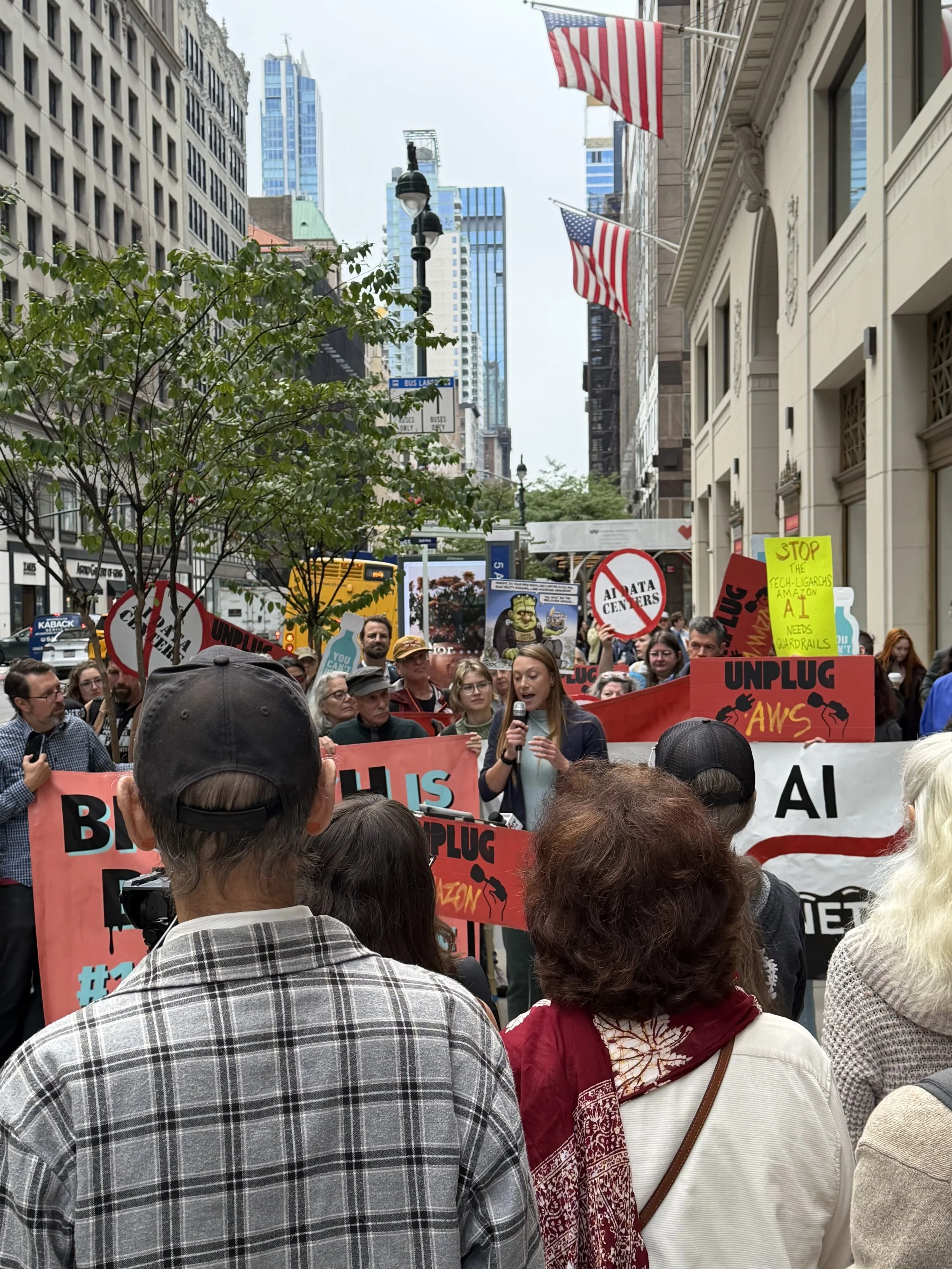
Protest outside Amazon offices, 12 West 39th Street, New York. Sept. 22, 2026. Photo: Jordan Famularo
